5. Discover the ownership

Who ultimately owns this company. Every company in the chain is a separate paid registry lookup, so nothing runs until you ask for it.

The empty ownership tab with a Start ownership discovery button
The walk is opened from the case, not started for you.

Two decisions, asked once

Press Start ownership discovery and you are asked for two numbers.

The Start ownership discovery dialog with a budget field and a materiality threshold field
How much the walk may spend on its own, and how small a stake stops being worth following.

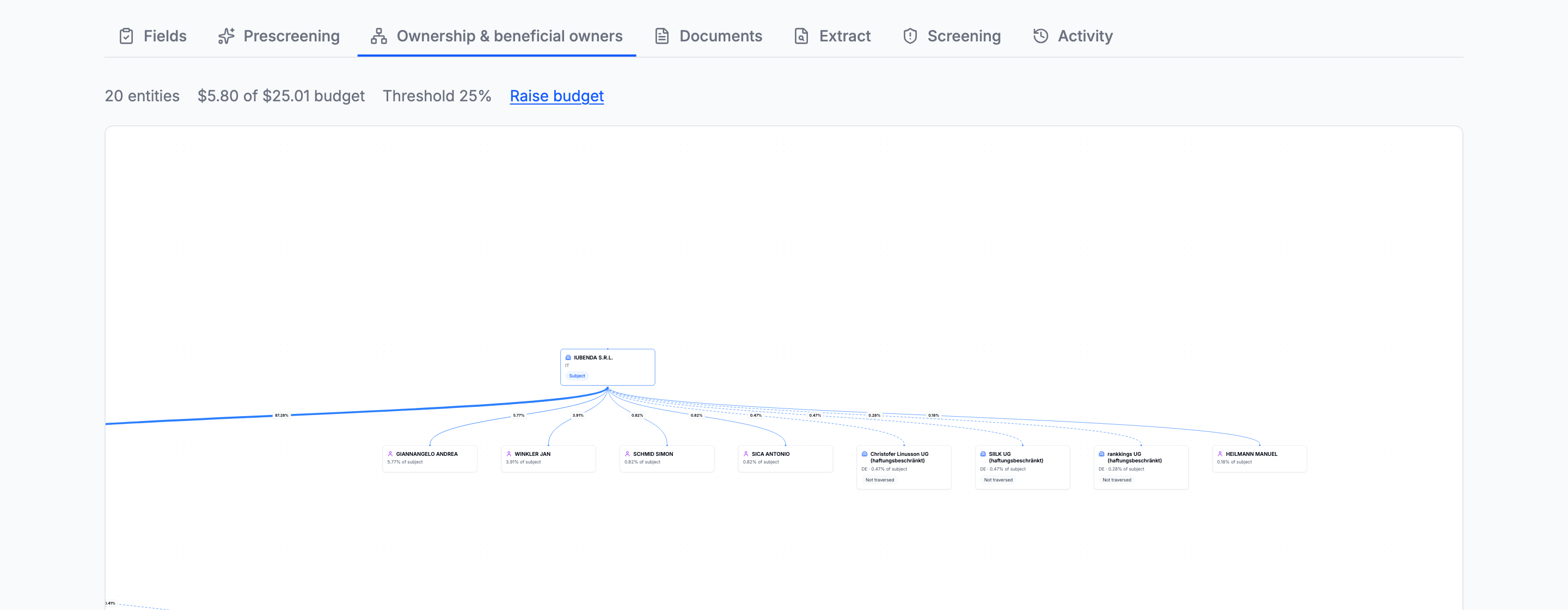
The budget bounds the walk, not you. It answers how far may this run on its own, asked before anybody has seen the structure. Each automatic step is quoted before it runs and charged against the budget; when it is gone the walk stops and says so, and Raise budget gives it more room.

The threshold is materiality. A branch is followed automatically when its effective stake in the subject is at or above it. Effective means the product along the chain, so a company held 50% by A which is held 30% by B puts B at 15%. Twenty-five percent is the common default.

Read more: Budget and threshold.

Watch it walk

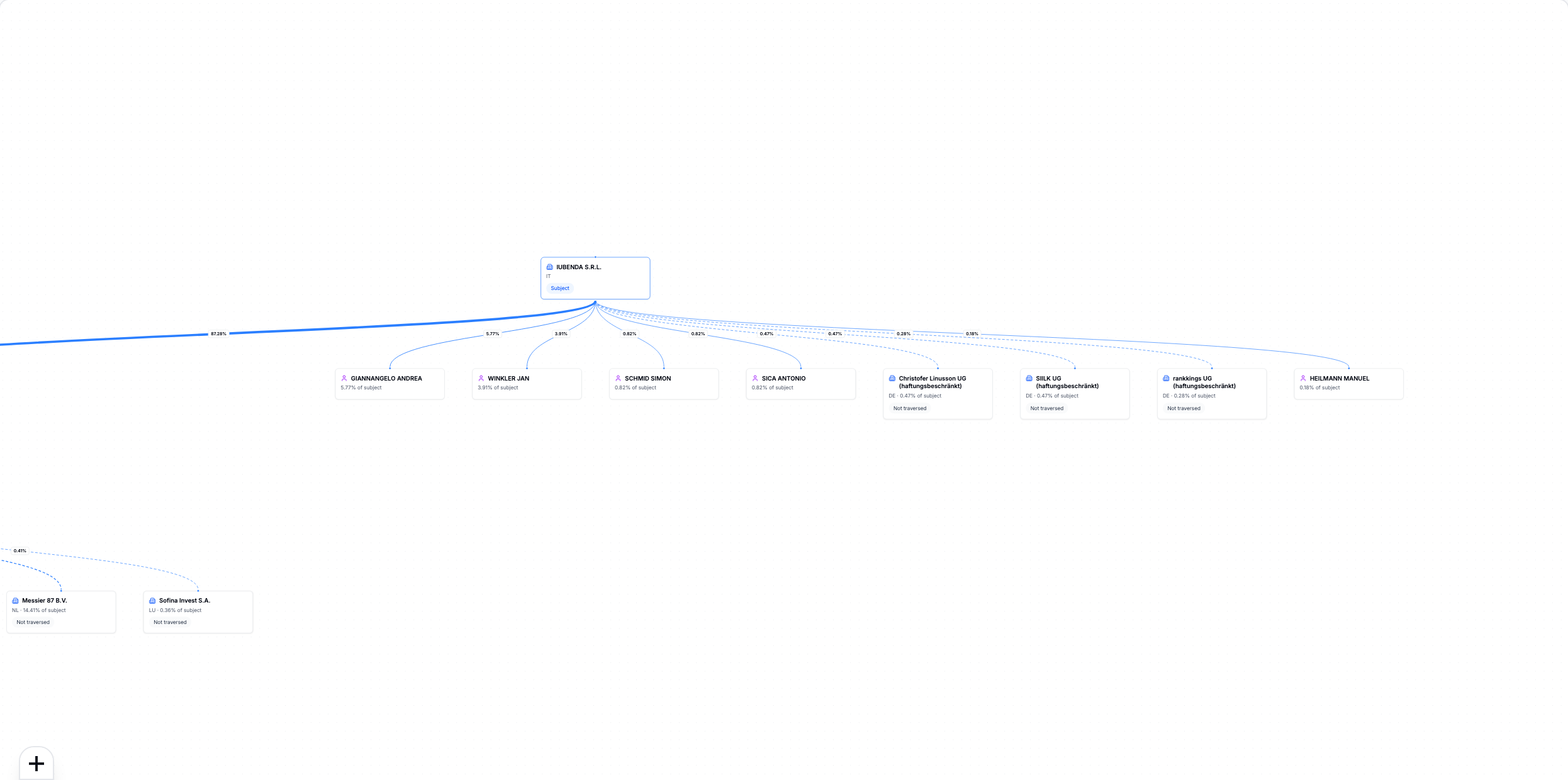
The ownership canvas showing the subject company at the top and shareholders above it, with percentages on the links
Each level is a paid lookup. The canvas fills in as they land.

The walk is conservative on purpose, and it declines a branch for exactly two reasons: the effective stake is below your threshold, or no stake was stated at all. Registers list pledge holders, trustees and security agents beside shareholders and often record no percentage. An unstated stake is unknown, not small, so nobody's budget goes on a guess.

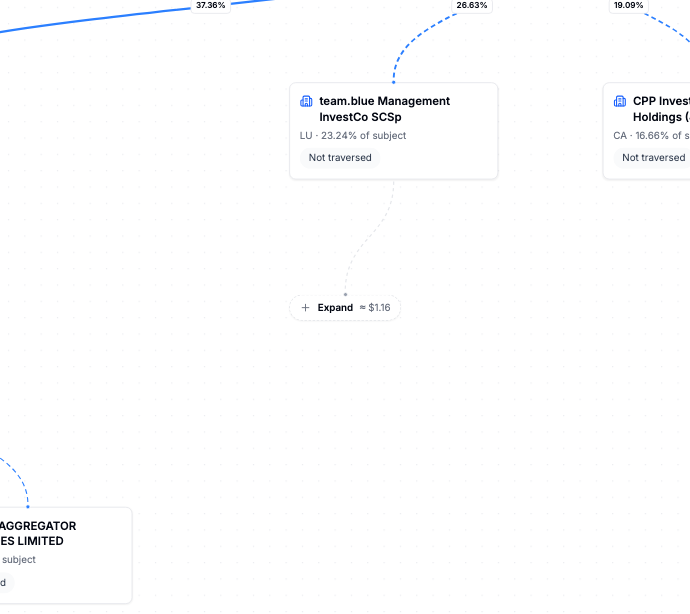
Everything it declines stays on the canvas with a price on it. Clicking Expand on a branch is your override: it ignores both rules, because that call belongs to you, and it is neither charged against the budget nor blocked by it. The price is on the pill before you click.

A frontier node on the canvas with an Expand button and the price of expanding it
A branch the walk did not follow, with what following it would cost.

The beneficial owners

Under the canvas is the table the walk exists to produce: the individuals whose effective stake meets the threshold, and the chain each of them holds through.

The beneficial owners table listing individuals with their effective percentage and the chain they hold through
Effective ownership, computed along each chain.
One unstated stake makes everything above it unknown

If a link in a chain records no percentage, the effective figure above it cannot be computed, and the platform says so rather than printing a number it cannot defend. That is a finding about the company, not a gap in the product.

If there is no register behind the case

A case entered by hand has no registry identifier to walk from, so its Ownership tab is an editor instead: the same canvas, the same arithmetic, the same beneficial-owner rule, with every card grown an Add holder pill. Nothing on that tab is charged. See Ownership entered by hand.


Next: Get the documents.

Going deeper: Ownership and beneficial owners · Reading the canvas