Disagreements
Two sources answering one field differently is not a fault. It is the reason for asking more than one.
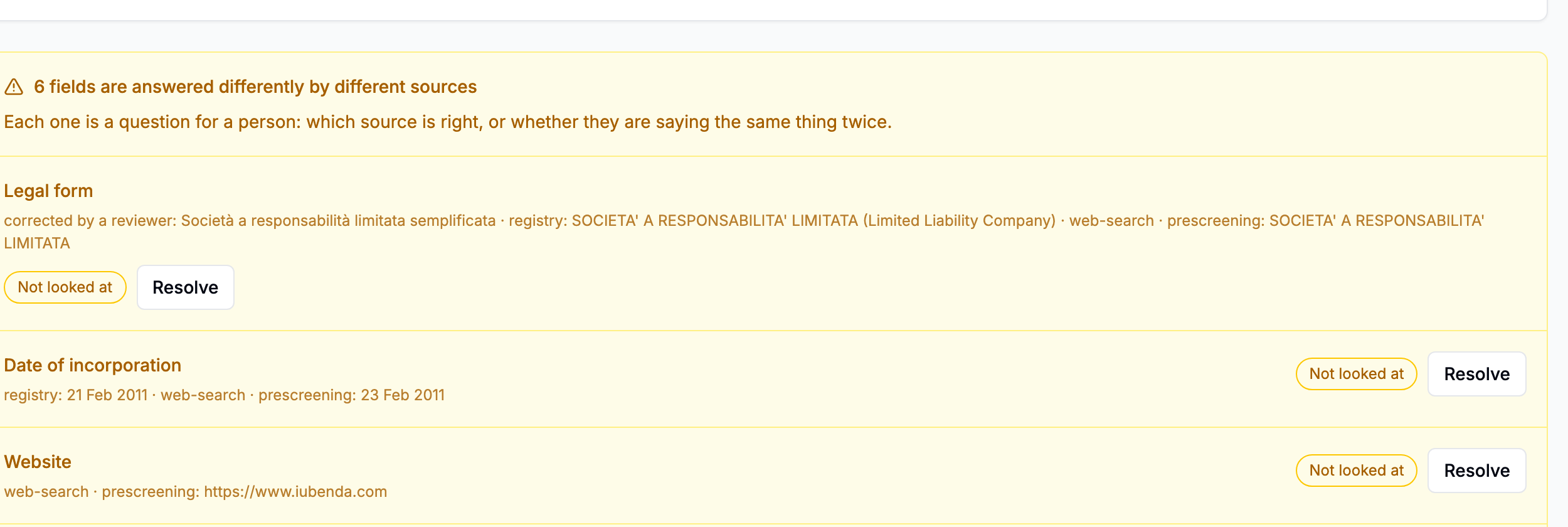
A resolution is not a correction
They are different acts and the product keeps them different.
| Correction | Resolution | |
|---|---|---|
| Says | "the value is X" | "you disagree, and here is my conclusion" |
| Produces | A new answer, ranked first | A judgement about answers that already exist |
| Effect on the case | Replaces the value | Explains it |
| In the report | The value, marked corrected by a reviewer | Nothing |
Using a correction to affirm a source does two harmful things: the field stays disputed, because the correction agrees with one source and still differs from the other; and the report then says corrected by a reviewer about a value nobody corrected. That line is the one thing in the document resting on a person rather than on a source, and it is the last place to be loose.
The three outcomes
Kept apart because they leave the next reader with different work.
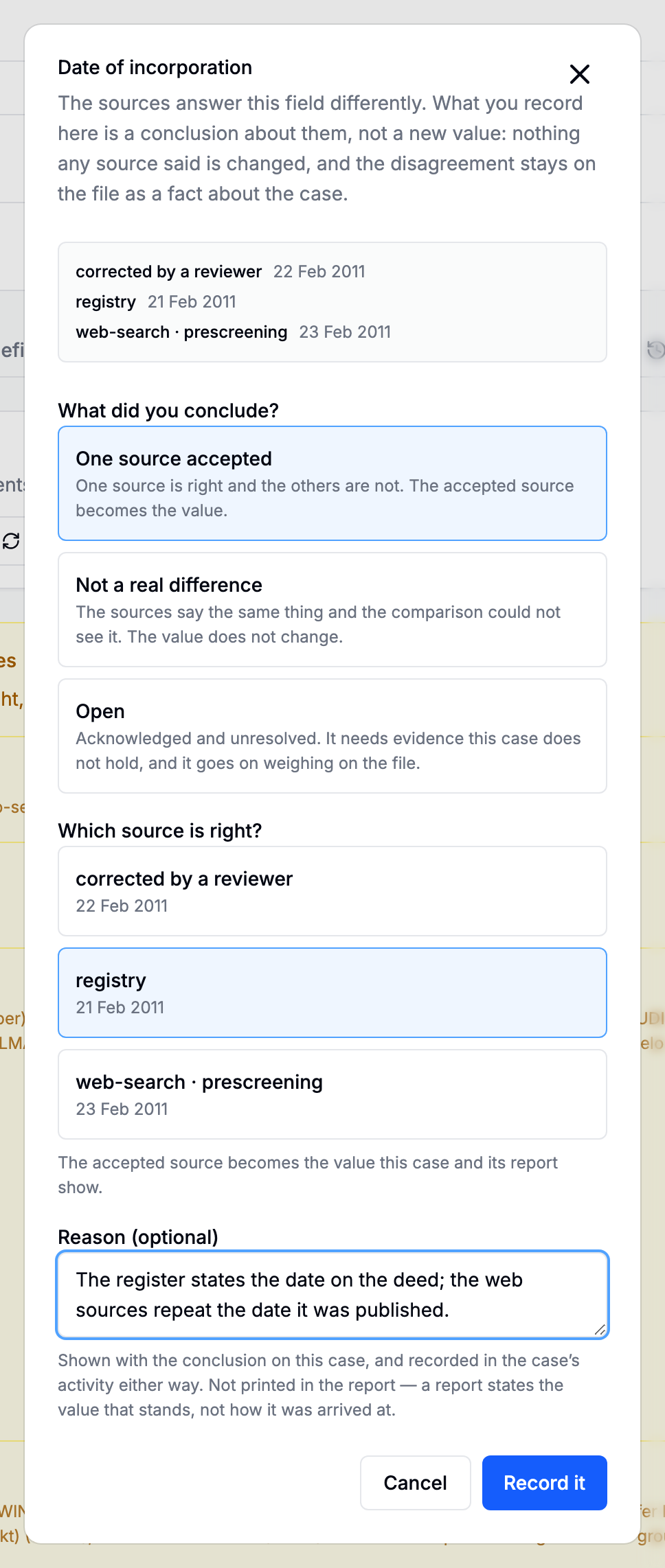
Accepted: one source is right and the others are not.
"The register is current; the filing states the 2023 address."
The accepted source's answer becomes the value, ahead of the ordinary precedence.
Not a difference: the sources agree and the comparison could not see it.
"Same person; the register writes the surname first."
The value does not change. What changes is that somebody looked.
Open: acknowledged and unresolved. It needs evidence the case does not hold. The only outcome that goes on weighing on the file.
The reason is optional, and its absence is a choice rather than an oversight. Write one anyway when the conclusion is not obvious from the two values.
A figure in the wrong currency
One disagreement needs no second source. A money field is compared as an amount — the currency is stripped, because the accounts carry it once as a field of its own — and that let a lone web figure of £351M stand as the total assets of a company whose accounts declare USD, uncontested, because nothing else answered the field.
Now every money figure is read against the Currency field. Where the figure states a currency and it is not the one the accounts declare, the field is marked disputed with the two currencies side by side, and it joins the review queue like any other disagreement. Nothing is converted and nothing is chosen: a figure the source converted and a figure from a different set of accounts look identical from here, and only a person reading the source can tell which. The report prints the same note under the value.
Where the accounts declare no currency, or the figure states none, nothing fires — there is nothing to compare.
Per holder, per appointment
A board or a shareholder table is not one disagreement. Where the sources argue about particular people, the queue decomposes into one row per party (a director two sources spell differently, a shareholder one source names and another does not) and each gets its own judgement.
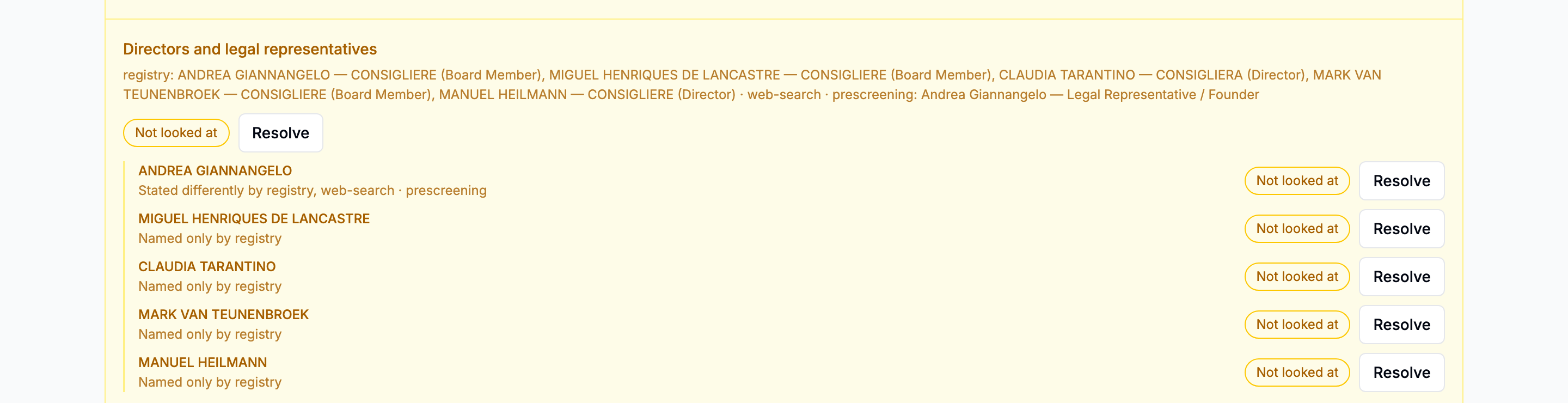
Those rows are offered only where they account for the whole disagreement. Where any source answered in prose, which is text belonging to no row, the field is resolved as a whole instead, so it can never leave the queue carrying a disagreement nobody was ever shown.
Staleness
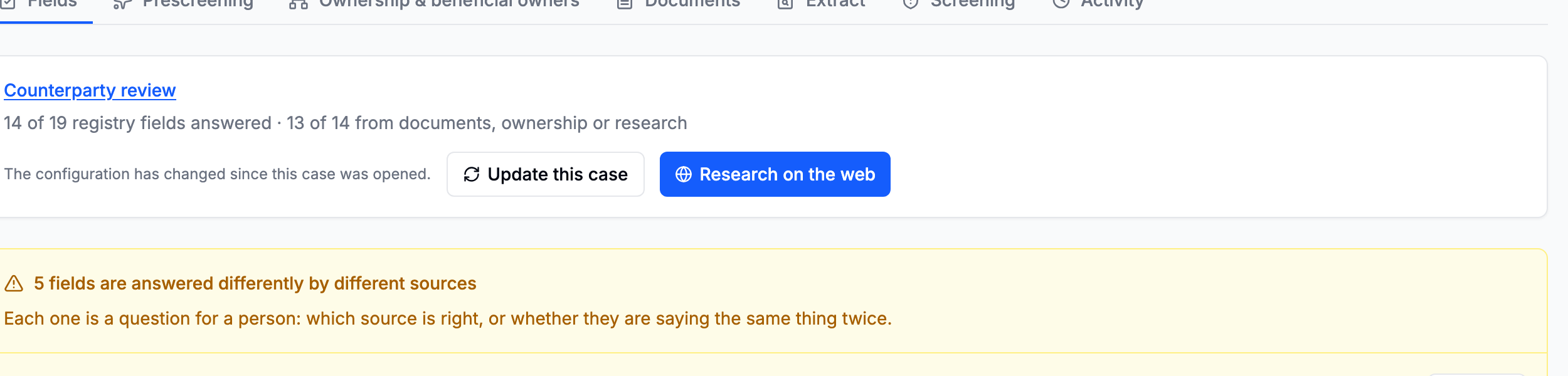
A judgement was made against a particular set of answers. When a document lands tomorrow and answers the same field, the judgement is about a different question.
So a resolution records which answers it was made against. When the current set differs, the resolution is stale: the field returns to the queue marked Sources have changed, carrying what was decided before and by whom, rather than being silently discarded.
What resolutions never do
- They do not make the field stop being disputed. The disagreement remains a fact about the case. What changes is that it has been adjudicated.
- They do not merge sources. Nothing in this product averages two answers.
- They are per case. A judgement on one company's file is not applied to another's.