Reading the canvas
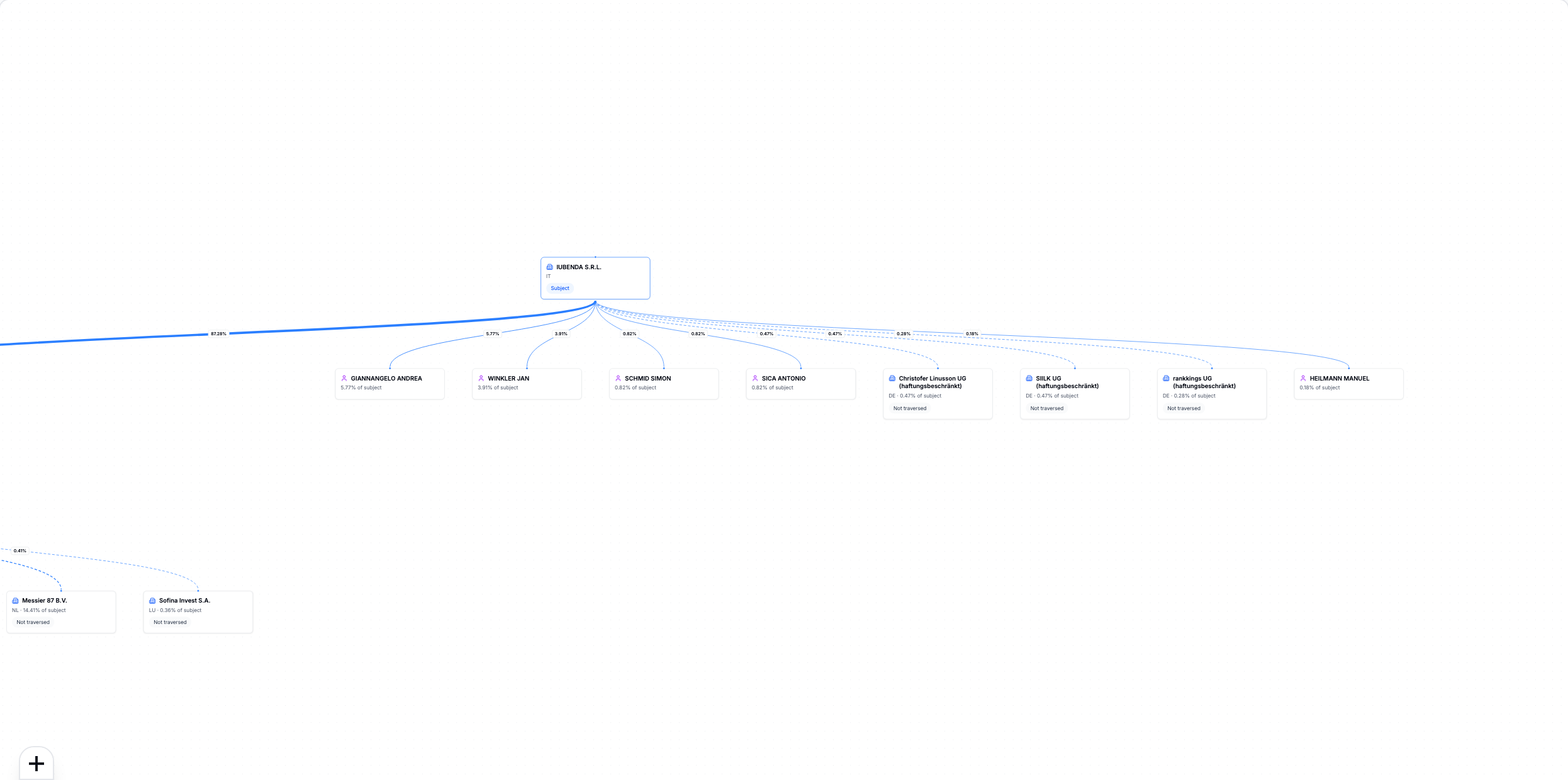
Nodes
| Node | What it is |
|---|---|
| The subject | The case's own company. It cannot be removed or renamed, because it is the case |
| A company | An entity in the chain that has been fetched: its own shareholders are drawn above it |
| An individual | A person. Chains end here, and individuals meeting the threshold are the beneficial owners |
| A frontier node | A company the walk found but did not fetch. Carries an Expand pill with its price |
| Coverage unavailable | A branch there is nothing behind, so no Expand, because a step there would resolve nothing |
Links
The percentage on a link is the stake in the entity directly below it, as the register stated it.
A link drawn thin and labelled related, stake not stated is exactly that: the register named the holder and recorded no percentage. It is not zero, and it is not small. It is unknown, and one unstated hop makes every effective figure above it uncomputable.
Expanding a branch
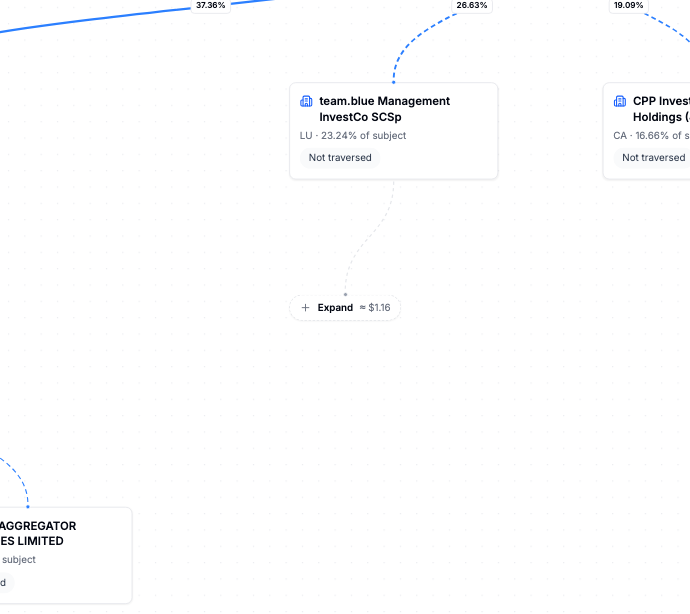
Expanding fetches exactly that company and draws its own shareholders, each of which becomes either a resolved node or a new frontier node.
What the walk found, listed
Under the canvas, two tables:
- Beneficial owners: individuals whose effective stake meets the threshold, with the chain they hold through.
- Material branches: the branches that carry enough of the subject to matter, whether or not they have been walked to the end.
Cycles
A owns B owns A happens, and the layout handles it: the cycle is drawn rather than followed for ever.
Effective ownership through a cycle is not invented.
The report draws the same thing
The report's ownership part carries a chart built from the same structure, plus the beneficial owners roster and the control basis statement. See What is in a report.